FOUR WEEKS OF WORK. ZERO RECIPIENTS?
The campaign is written, designed and approved. Then the send screen says nobody may receive it. CMP42 asks that question on day one, and keeps asking it.
FIVE DOORS, ONE INBOX.
Your leads come from five places: Meta and LinkedIn lead forms, the form on your website, a badge scanner at the trade fair, and the booking link in your e-mail signature. All of them end up in the CRM as contacts. Each one looks the same. Each one arrived with different evidence.
THE CHECK COMES LAST?
The CRM checks consent last, at the send button. A lead form ran on Meta’s page, not yours, so its checkbox is something you were told, not something you recorded. A business card is a person you met, not a permission. A LinkedIn profile is a name, not a channel. None of it shows until the list is built, and by then the work is done.
TWO QUESTIONS EVERY DAY. CMP42 ASKS THEM FIRST.
May we talk to this person? Then: is it worth it?
CMP42 asks two questions, in this order. First, whether anyone may contact this person at all: on which channel, in which country, for which purpose. The answer is eligible, eligible after a named action, or not eligible with the reason.1 An agent proposes the next lawful step, such as the requested whitepaper with a confirmation link, the account in a company-level ad segment, or a meeting at the conference where the person speaks. A person takes it. A record with no lawful path expires.1
¹ Planned for the next release.
SEVEN THINGS CMP42 CARRIES FOR YOU.
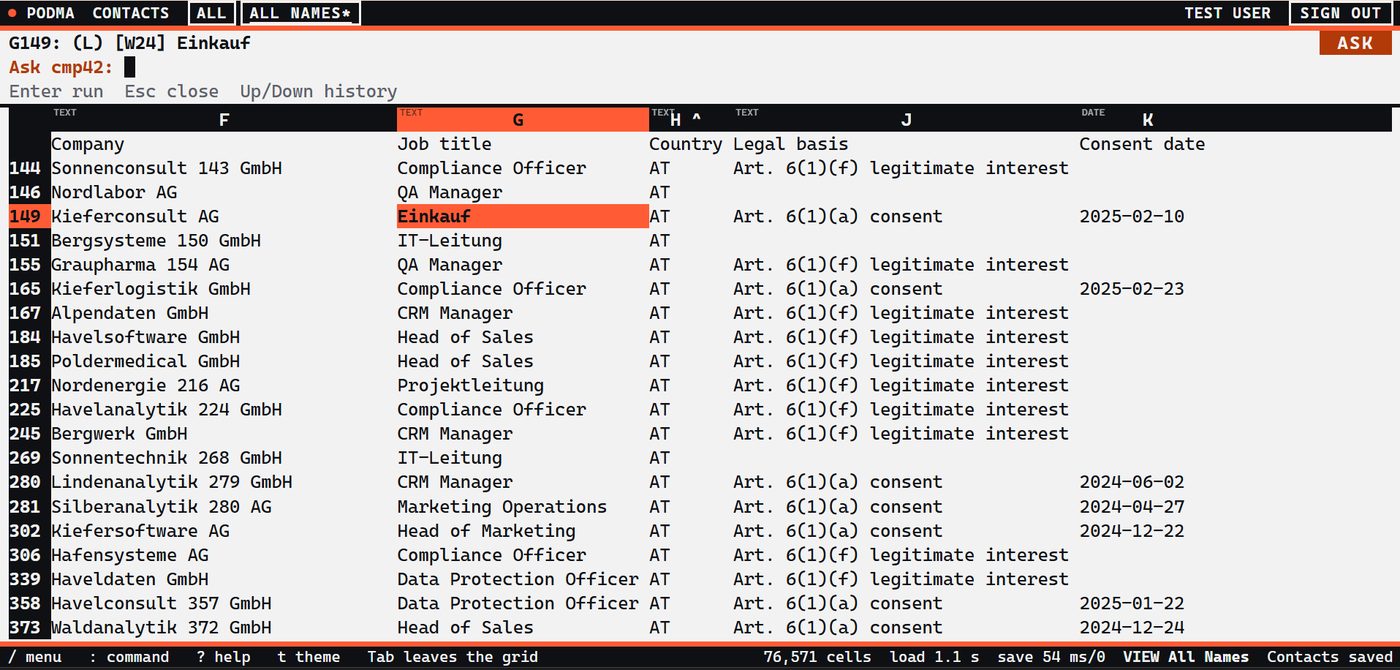
- People — the person and each channel identifier, with legal basis, consent date and consent source.
- Organizations — the company, its country, and the account a company-level ad segment targets.
- Relations — the edge itself: which person belongs to which company, and since when. A lawful path often runs through the organization, not the person.
- Events — every touch and booking, and published speaker or exhibitor appearances.1
- Content — the exact consent text a person saw, as a version.1
- Intent — a qualification assessment with the evidence behind each criterion.1
- Process — lifecycle stages and the next lawful step. Agents propose, people decide.1
¹ Planned for the next release.
WHAT RUNS TODAY, AND WHAT COMES NEXT.
| In the Alpha, from October 2026 | Planned¹ |
|---|---|
| Legal basis, consent date, consent source, origin and reason codes on every contact, in the Podma Workbench. | The reachability check per channel, country and purpose, with its reason. |
| No recipient list without approval: every list is checked against your legend, in the database. 1,000,000 records in 2.1 seconds, measured on a small 2-vCPU machine. | A live eligible count the moment an audience is defined. |
| Run the approval check on any view, at any time, not only before a send. | Lifecycle stages whose every move cites its evidence. |
| By command, agents rearrange views and columns; commands that write or delete values are closed to them. | Qualification assessments: BANT for a person, MEDDICC for a deal. |
| Every write names tenant and person, and whether a person or an agent made it. | Lead forms from Meta, Google and LinkedIn, labelled for what they prove. |
| Jurisdiction templates, first for the EU / EEA, Switzerland and the UK. |
What CMP42 does not do: decide for you whether a campaign is lawful. The templates encode the rules; you remain the controller. They support your documentation under GDPR Art. 5(2) and Art. 7(1); they are not legal advice.
¹ Planned for the next release.
WHERE IT FITS WHAT YOU ALREADY RUN.
Agents work over MCP. Lead forms arrive with the ad, form and campaign IDs the platforms deliver.1 Your booking link carries a signed context token, so a meeting arrives already linked to its deal or campaign.1 The self-hosted image follows at Beta in Q1 2027.
¹ Planned for the next release.
ALPHA FROM OCTOBER 2026.
Design partners shape what ships next, starting with the reachability check.
→ Book a call on the partner page