
ANNOUNCING CMP42.
THE HEADLESS CRM FOR THE ERA IN WHICH AI IS THE UI.
Twelve Design Partners. Six months of Alpha. A schema built for agents, not for humans clicking. A Context + Models + Processes graph that ChatGPT, Claude, your team's Slack bot — and the agent you have not chosen yet — can all read and write against.
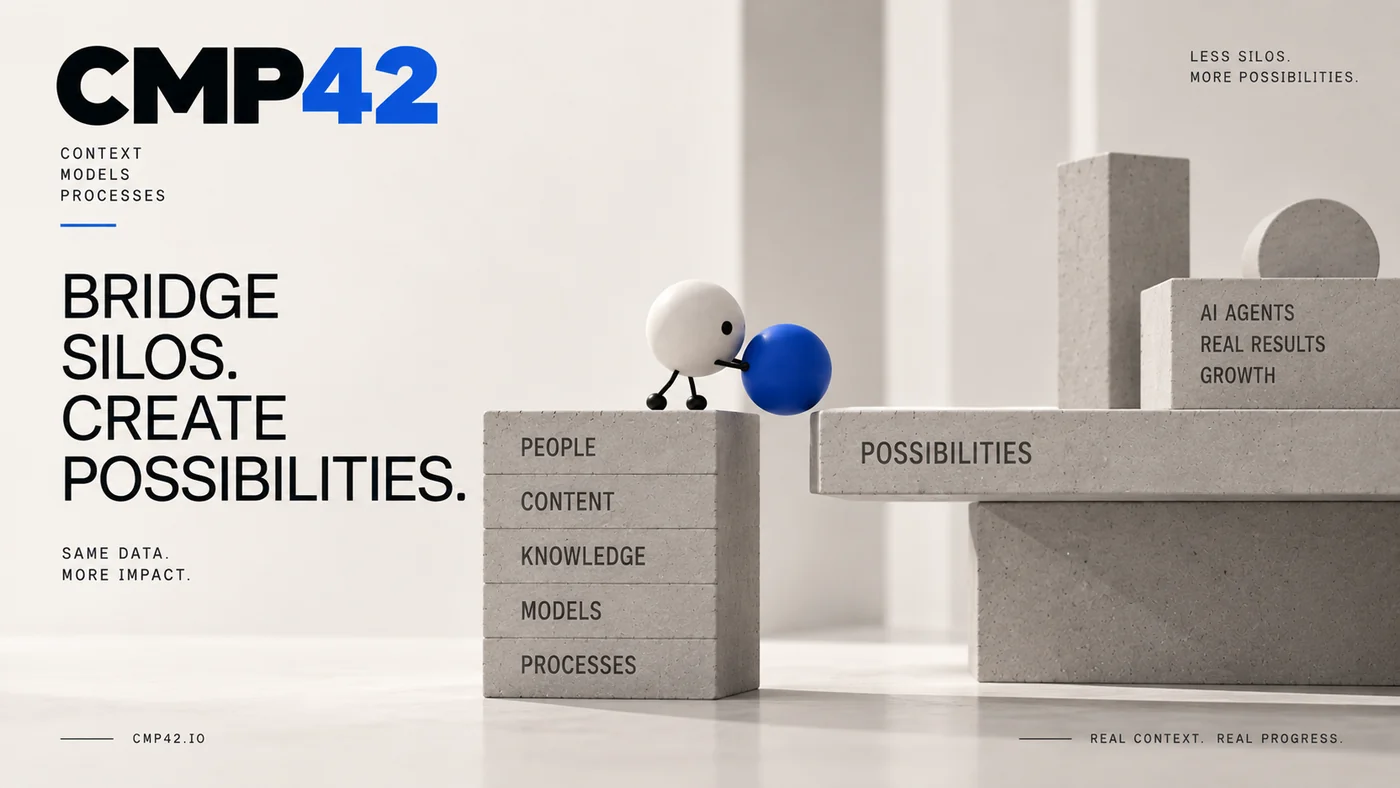
Something quiet has happened in the last twelve months. Ask a sales manager how they check the pipeline. A year ago the answer was "I open HubSpot." Today the honest answer is "I ask my agent to summarise it, and if the summary looks off, I open HubSpot."
Ask a partner in a consulting practice how they draft the follow-up note after a client call. A year ago it was Word. Today it is Claude, with a paste of the meeting transcript and a "make it sound like me." The database has not moved. The workflow has.
The CRMs we have — HubSpot, Salesforce, Pipedrive — were designed on an assumption that turns out to be temporary: that a human would open the UI. Every field, every pipeline, every dashboard exists because someone was going to click on it. When the agent tries to read the same schema, it treats it like a chat history: it hallucinates the missing bits, it invents fields that were never declared, it fabricates a stage that is not in the pipeline. Not because the model is bad. Because the schema was not built for the reader.
The bet: CRM is a graph problem now.
CMP42 is what happens if you build a CRM knowing the primary reader will be an agent, and the primary writer will be a human helped by an agent.
It has three deliberately small parts:
1 · Context — the connected object graph
Contacts, companies, deals — yes. Also documents, meeting recordings, product briefs, playbooks. Every object has a typed identity. Every edge is named (contact knows company, contact owns deal, partner authored doc). Every field is addressable by URI. Every write is versioned and attributable.
The agent reads this like a database, not like a chat log. Ask it "who at Aspen owns the Q4 renewal and what was the last thing they published on this topic?" — the agent walks the graph and answers with citations, not with vibes.
2 · Models — the ontology you version like code
Sensible defaults for the CRM primitives. Then you extend. Models live in git-versioned YAML. A single command migrates them. Every model automatically becomes a set of MCP tools — get_contact, list_deals_at_stage, write_note_on_company — that any MCP-compliant client can consume.
Your ontology is a first-class product artefact. Not a Salesforce setting somewhere behind three tabs. Not a hidden schema owned by an ops team you never see.
3 · Processes — human-plus-agent workflows, observable
A process is a named sequence of steps. Some run on humans (a partner reviews a case note). Some run on agents (Claude drafts the follow-up). Each step reads and writes to the graph. Each transition is logged. Each run is replayable.
You audit an agent's work the way you audit a git branch: what did it read, what did it write, at what token cost, and can you replay the same process against last month's snapshot and check whether the answer would have been different.
What we refuse to build.
The list is deliberate. It is also the reason CMP42 exists.
- No forced UI. The admin surface is a data table and a migrations CLI. That is it. Your team already has an interface — it is called ChatGPT, Claude, Slack, or the app your engineers will build next month. CMP42 does not compete with it. CMP42 feeds it.
- No "AI insights" layer. We ship no proprietary model. You bring the agent you trust. CMP42 gives it grounded context, agent produces the insight. If we shipped a black box, we would be part of the problem we set out to fix.
- No 200-field contact object. Defaults are lean. Extension is explicit. Silence is a feature.
- No cookie banner, no third-party scripts. Same posture as everything else protagx ships. GDPR-native, EU-hosted, self-hostable if you want.
What we ship instead: MCP tools day one, REST + GraphQL parity, git-versioned models, replayable processes, and a boring API that gets out of the way.
The Design Partner Program is open.
Twelve companies. Six months of Alpha starting October 2026. Direct-Slack access to the founder, a monthly co-design call, priority feature requests, and the right to propose and name one MCP tool that ships to every future customer. Fixed price of €6,900 one-time. We ask for real usage and honest feedback in return.
→ Apply to be a design partnerTimeline.
The path to GA
- NOW
- Design Partner Program opens. Twelve slots.
- OCT 2026
- Alpha begins with first Design Partners. Weekly release cadence.
- Q4 2026
- MCP tool surface stabilises. First case studies published.
- Q1 2027
- Beta opens to a broader waitlist. Self-hosted image published.
- H1 2027
- General availability. Pricing published. Design Partners keep their lifetime rate.
Who this is for.
Boutique consultancies whose competitive advantage lives in a framework they keep re-explaining. That framework becomes the context an agent uses on the next engagement.
Product-led B2B teams who want an agent to read a real customer's history before drafting the renewal note — not the generic ChatGPT summary that gets the account name wrong.
Agencies with AI ambitions already selling AI to their clients. Sell them the version that grounds on their real accounts, not the demo that hallucinates a competitor.
Anyone leaving HubSpot who wants lean data plus a real API, not another platform to migrate onto next year.
Why now.
Because the workflow already moved. Every honest CRM user I speak to has one of two setups: they have wired their CRM into an AI agent through Zapier and a lot of Python, and the results are inconsistent because the schema was not built for agent reading; or they have given up and copy-paste transcripts into ChatGPT.
Either way, the CRM is not the tool that runs the day. It is the database that gets consulted after the fact. If that is the honest role, let us build it for that role.
"CRM UIs are dying. AI is the UI now. But AI without context is autocomplete on a hallucination."
CMP42 is the context. Berlin-built. GDPR-native. Self-hostable. Small enough to hold in your head, big enough to feed the agents you have not chosen yet.
If any of the above describes the mess on your desk, come and Alpha it with us.